Cloud Operating Model Framework: Roles, Processes and Tools

Cloud success depends less on adding another platform than on aligning the people, processes, and technology behind it. A cloud operating model framework brings these elements together so teams can deliver and manage cloud services in ways that support business goals. It connects strategy to everyday decisions about ownership, governance, security, automation, and infrastructure.
When cloud operations feel fragmented, the challenge is not simply technical. Clear responsibilities and repeatable processes matter as much as the tools themselves. This guide explains how these elements fit together and how a well-designed model can balance current operations with future goals.
You’ll learn how roles, governance, automation, infrastructure as code, and security contribute to a coherent approach. You’ll also see how operating models divide responsibilities and what to consider as your organization adopts cloud capabilities and evolves its ways of working.
Table of Contents
Automation, infrastructure as code, and self-service security
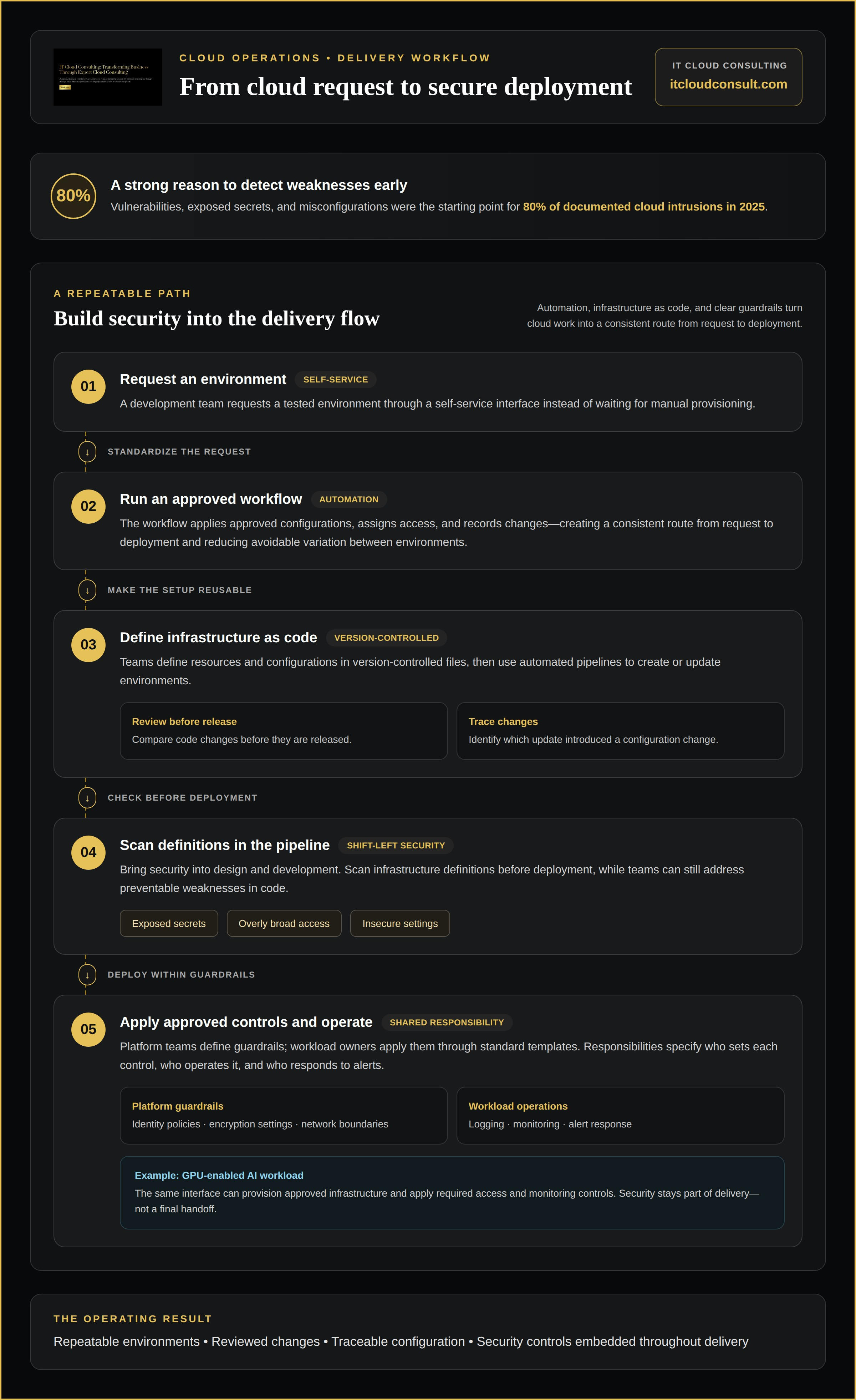
Automation turns a cloud request into a repeatable workflow. For example, a development team can request a tested environment through a self-service interface instead of waiting for manual provisioning. The workflow can apply approved configurations, assign access, and record changes. This creates a consistent route from request to deployment while reducing avoidable variation between environments.
Infrastructure as code makes that workflow reusable. Teams define resources and configurations in version-controlled files, then use automated pipelines to create or update environments. A reviewed change can provision a test environment with the same network rules and access settings as production. Teams can compare code changes before release and trace which update introduced a configuration change. Together, these capabilities make infrastructure easier to reproduce and manage.
Security-first, shift-left operations bring controls into design and development rather than waiting for production. A pipeline can scan infrastructure definitions for exposed secrets, overly broad access, or insecure settings before deployment. Vulnerabilities, exposed secrets, and misconfigurations were the starting point for 80% of documented cloud intrusions in 2025. That finding reinforces the value of detecting preventable weaknesses early, while teams can still address them in code.
Self-service security gives workload teams approved controls within clear guardrails. Platform teams can define identity policies, encryption settings, network boundaries, logging, and monitoring; workload owners then apply them through standard templates. Responsibilities should specify who sets each control, who operates it, and who responds to alerts. For a GPU-enabled AI workload, the same interface can provision approved infrastructure and apply required access and monitoring controls. Security remains part of delivery, not a final handoff.
What is a cloud operating model?
A cloud operating model connects business objectives with the people, processes, and technology that deliver cloud services. Its scope includes governance, architecture, security, cost management, and operational ownership.
Defining the Model and Its Scope
A cloud operating model is the coordinated way an organization designs, governs, delivers, and improves cloud services. AWS describes an effective model as one where people, processes, and tools support one another. That coordination matters because cloud decisions must connect technical implementation with organizational goals. A useful model also clarifies which services teams provide, who owns them, and how they evolve. Define a cloud product by its users, business outcome, accountable owner, support boundaries, security needs, and lifecycle. These criteria make shared capabilities easier to manage and measure.
Building the Model Step by Step
Building a cloud operating model means translating strategy into clear ownership, working practices, and measurable outcomes. Start by mapping business priorities and current capabilities, then identify workloads and their operational needs. Assign owners for governance, security, platform operations, and each workload. Define shared policies and service expectations, then establish processes for provisioning, change, incident response, and cost review. Introduce automation where standardization benefits repeatable work. This sequence matters because teams need aligned responsibilities before scaling cloud services. Reassess the model as workloads and organizational priorities change.
AWS, Microsoft Azure, and Google Cloud differ in their services and management tools, but organizations can apply consistent operating principles across all three. Align ownership, access controls, deployment practices, cost visibility, and service performance, then adapt implementation to each provider’s capabilities.
FinOps belongs in routine service management, not in a separate finance exercise. Assign teams responsibility for understanding cloud consumption, allocating costs to workloads, and reviewing usage against business value. This helps them make informed optimization decisions.
Measure maturity through operational indicators tied to business outcomes, such as provisioning lead time, deployment consistency, policy compliance, service reliability, and cost allocation coverage. Establish a baseline, review trends with accountable owners, and use gaps to prioritize improvements instead of treating maturity as a one-time score.
Cloud operating models versus governance and traditional IT
A cloud operating model shapes how teams deliver services, while governance sets decision boundaries. Together, they connect cloud strategy with daily operations.
Distinguishing Operations from Governance
A cloud operating model coordinates cloud service delivery; governance defines policies, controls, and oversight. Traditional IT provisioning can take days or weeks, while automated cloud processes can help teams access resources sooner. A cloud adoption framework, by contrast, guides an organization through planning and adopting cloud capabilities. The operating model defines how those capabilities are managed afterward, clarifying ownership and execution.
Assigning Governance Responsibilities
Cloud governance assigns owners to assess risks, establish policies, and monitor progress before workloads launch. A responsibility map should name primary and backup owners for governance, security, and operations. For example, a platform team may maintain baseline controls while a workload team manages application access within them. Document partner responsibilities alongside internal roles. The Institute of Electrical and Electronics Engineers (IEEE) emphasizes that data-compliance issues span the cloud supply chain, not just application boundaries.
Connecting Strategy, Governance, and Security
Cloud strategy sets business priorities; governance translates them into decisions, and security controls protect workloads as teams deliver them. For example, if a strategy prioritizes rapid product releases, governance can define approved deployment paths and security reviews. Before deployment, teams should assess risks, set policies, and establish monitoring. This sequence connects intended outcomes to practical safeguards instead of treating security as a separate final approval.
Assessing Benefits, Risks, and Failure Modes
A well-defined operating model can support faster adoption and greater transformational value, but unclear ownership can undermine both. Common failure modes include overlapping responsibilities, policies that teams cannot apply consistently, and governance introduced only after deployment. For example, separate cloud processes can obscure accountability. Review the model as the organization scales, checking whether ownership, controls, and operations still support strategic goals and current workloads.
People, process, and technology in cloud operating models
People, process, and technology create value when they operate as one system. A platform team may provide shared standards, while application teams own service outcomes. Processes connect these roles through clear handoffs for changes, incidents, and approvals. Technology then supports the agreed work instead of dictating responsibilities. This alignment turns collaboration into operational agility: teams can adapt services without losing accountability.
A practical model defines each role through decisions and outcomes. For example, a product owner prioritizes business needs, a platform engineer maintains shared capabilities, and a security lead shapes control requirements. A responsibility map shows who approves a change, who implements it, and who responds to an incident. AWS says people, processes, and tools must support one another effectively. This principle helps prevent mistaking a new tool for an operating model.
Processes make collaboration repeatable. A service change might move from a team request to impact review, approval, release, and operational monitoring. Each stage needs an owner, useful documentation, and a clear route for exceptions. Training and onboarding explain responsibilities to business stakeholders and technical teams. For instance, a new application team can use a service catalogue to understand approved options and escalation paths before deployment.
Technology should reinforce those practices with capabilities teams can use consistently. A shared service catalogue, monitoring dashboard, and change record can connect platform and workload teams around the same operational view. Leaders can then assess whether handoffs create delays, incidents reveal unclear ownership, or teams repeatedly bypass agreed processes. Treat these signals as opportunities to refine the model, not simply as individual performance issues.
If role ownership or cross-team handoffs need refinement, strengthen cloud operating model alignment with focused strategic guidance.
IT Cloud Consulting
IT Cloud Consulting helps organizations connect cloud strategy with practical operating decisions. Its Strategic Cloud Adoption offering supports planning for cloud capabilities, roles, and governance, while Cloud Optimization helps refine existing operations. Ongoing Cloud Support provides continued assistance as workloads and priorities change.
Consider this support when teams need to establish clearer ownership, align cloud processes with business goals, or improve existing cloud operations. The right focus depends on your organization’s current capabilities and the outcomes its operating model must support. Strategic guidance can help turn those priorities into a coherent path forward.
Contact IT Cloud Consulting to discuss your cloud operating model needs.
Make Your Cloud Model Ready to Evolve
A cloud operating model framework is most valuable when it can evolve with business priorities rather than become a fixed blueprint. Treat it as a living agreement between teams: revisit ownership, decision paths, and service expectations as workloads or organizational needs change. This discipline helps preserve momentum without losing sight of accountability.
The next step is to identify where your current approach creates friction, then decide which operating changes would make the greatest difference. IT Cloud Consulting supports this work through Strategic Cloud Adoption, Cloud Optimization, and Ongoing Cloud Support, aligning guidance with your organization’s needs and direction.
Contact IT Cloud Consulting to discuss the right next step for your cloud operations. With a clear path and the right alignment, your operating model can keep pace with what the business is ready to achieve.
Frequently Asked Questions
What is a cloud operating model framework?
A cloud operating model framework is a structured way to align cloud decisions, service delivery, and accountability with business goals. It helps teams determine how cloud work should be planned, governed, and improved. For example, an organization launching a customer portal can use it to clarify ownership, approval paths, operating expectations, and how the service will be reviewed after launch.
What are the core components of a cloud operating model?
Core components include decision-making structures, service management processes, technical platforms, and performance measures. A service catalogue, for example, can show which platform capabilities teams may request and what information each request requires. Monitoring and cost views then help teams assess whether a service performs as intended and uses resources effectively. These elements connect delivery choices with ongoing operational management.
What roles and responsibilities are needed in a cloud operating model?
Responsibilities commonly span business ownership, platform management, workload operations, security, and financial oversight. A business owner defines the outcome a service must support; a workload team maintains the application; and platform specialists manage shared foundations. Assign decision rights for exceptions, incident escalation, and service retirement. A responsibility map helps teams distinguish who approves, performs, and monitors each activity.
How should cloud governance, security, and compliance be structured?
Structure governance around accountable owners, documented policies, and evidence that controls operate as intended. For example, a control register can connect an access policy to its owner, review process, and supporting records. Security teams can define baseline expectations, while workload teams apply them to specific services. Track exceptions with an owner and resolution path so they remain visible during operational reviews.
What are common cloud operating model frameworks and reference architectures?
Common reference architectures include a cloud landing zone for foundational account, identity, and network configuration; a hub-and-spoke network for connecting shared services with workloads; and workload-specific designs for applications with distinct requirements. These are architecture patterns, not complete operating models. Pair a suitable pattern with ownership, governance, and operational practices so teams know how to deploy, support, and evolve each environment.
Comments